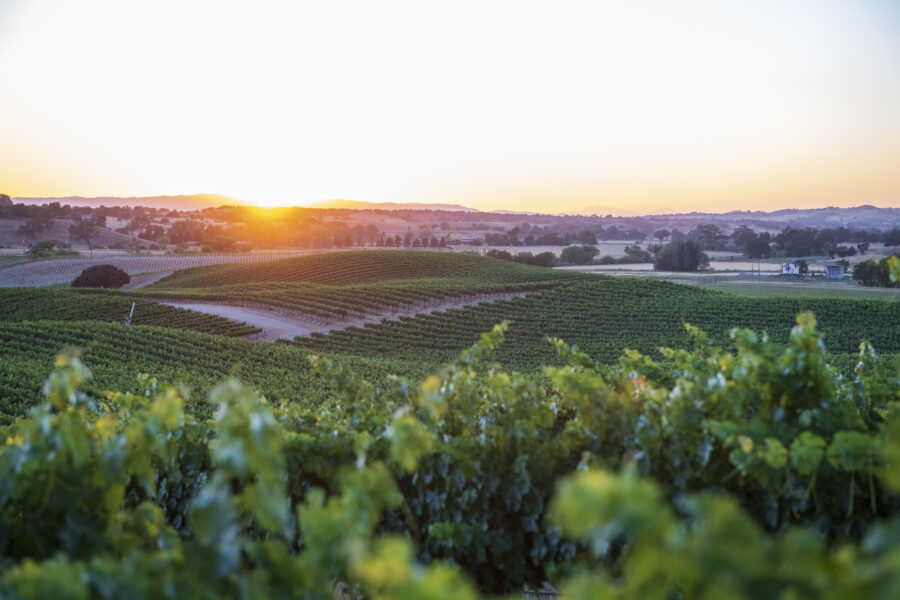
Crush is the busiest stretch of the winemaking year. It’s the window when a full season of sun, wind, and soil finally arrives at the cellar as fruit, and every decision about picking, sorting, and fermentation shapes the wine in the bottle. At the Riboli Family estate in Paso Robles, crush season is where the character of five distinct vineyards is captured, one lot at a time.
When Paso Robles Harvest Season Happens
Paso Robles harvest season generally runs from late August through October, with the exact timing set by the grapes rather than the calendar. White varieties and early-ripening grapes usually come in first, followed by the reds as they build sugar and phenolic ripeness into the fall.
What drives the timing here is the region’s dramatic diurnal swing. Warm daytime temperatures push ripeness forward, while cool afternoon and evening breezes funneling through the Templeton Gap drop nighttime temperatures sharply. That day-to-night swing lets fruit develop concentrated flavor while holding on to the natural acidity that gives the wines balance and structure. Because cooler fruit is firmer and more stable, much of the picking during grape crush in California happens overnight and in the early morning hours.
The Riboli Family Vineyards in Paso Robles
The Riboli Family vineyards in Paso Robles span several sub-appellations and soil types, and each site is picked and vinified separately so its personality carries through crush.
Maddalena Vineyard, named for family matriarch Maddalena Riboli, sits in the El Pomar District AVA on steep hillsides of Linne-Calodo calcareous soils derived from ancient seabeds. Those lean soils force the vines to struggle, producing concentrated wines with a distinctive mineral character.
Stefano Vineyard, named for family patriarch Stefano Riboli, is also in the El Pomar District. Its Arbuckle-Positas soils, packed with multicolored rocks across steep hillsides, yield deeply colored, concentrated fruit.
Pretty Penny Vineyard, likewise in the El Pomar District, combines steep hillsides and rocky Arbuckle-Positas soils with the same cooling Templeton Gap breezes to produce concentrated wines.
Creston Highlands Vineyard lies along the rolling hills of the northeastern Creston District, on soils derived from calcareous marine deposits that are unusual for the AVA.
Riboli Creston Vineyard, in the newer Creston District, pairs well-drained Arbuckle-Positas soils and clean water with warm days and cool nights, set around a bird-sanctuary lake.
From Vine to Crush Pad
Crush begins before any fruit is picked. Winemakers walk the rows, sampling grapes and testing sugar (measured in Brix), acidity, and pH, then taste the berries and seeds to judge ripeness. When a block hits its target, that lot is scheduled for harvest.
Once picked, grapes move quickly to the crush pad to preserve freshness. Clusters are sorted to remove leaves, stems, and any underripe or damaged fruit. From there, the paths for white and red wines diverge:
- White grapes are typically pressed soon after arrival, separating the juice from skins and seeds before fermentation to keep the wines crisp and bright.
- Red grapes are destemmed and crushed, then fermented on their skins so the juice can pull color, tannin, and flavor from the skins during fermentation.
Fermentation converts the grape sugars into alcohol, either with cultured yeast or native yeast, depending on the lot. Keeping vineyards, and often individual blocks, fermented separately gives the winemaking team the flexibility to blend with precision later, or to bottle a standout site on its own.
Why the Terroir Matters at Crush
Everything that happens during a crush is an effort to protect what the vineyard has already built. The calcareous and rocky soils across the Riboli sites naturally limit vine vigor, concentrating flavor in smaller, more intense berries. The Templeton Gap’s cooling influence preserves acidity through the warm growing season. Handling that fruit gently and quickly at harvest is what carries those qualities, concentration, minerality, structure, from the hillside into the glass.
Visiting Paso Robles During Harvest
Fall is one of the most rewarding times to visit wine country, when the vineyards are active and the cellar is full. Guests can experience the Riboli Family’s Paso Robles home through tastings and its on-site Maddalena Restaurant, and learn more about the estate vineyards on the Paso Robles vineyards page.
FAQs
When is harvest season in Paso Robles?
Harvest typically runs from late August through October. The precise start depends on the growing season and each variety’s ripeness, with whites and early-ripening grapes usually picked before the reds.
Why are grapes often harvested at night?
Cooler nighttime and early-morning temperatures keep the fruit firm and fresh, preserve acidity, and slow oxidation before the grapes reach the crush pad. In a warm region like Paso Robles, night harvesting helps protect flavor and quality.
What’s the difference between harvest and crush?
Harvest is the picking of the grapes; crush refers to the processing that follows—sorting, pressing whites or destemming and crushing reds, and starting fermentation. The two happen back-to-back, which is why the whole period is often just called “crush season.”
How many estate vineyards does the Riboli Family farm in Paso Robles?
The Riboli Family farms several estate vineyards across the Paso Robles region, including Maddalena, Stefano, Pretty Penny, Creston Highlands, and Riboli Creston, spanning the El Pomar and Creston Districts.
Can I visit the winery during crush season?
Yes. Fall is a lively time to visit. You can enjoy tastings and dining at the Riboli Family’s Paso Robles location; booking ahead is recommended during the busy harvest season.